

Product
- Fatty acid value tester
- Amylose tester
- Rice freshness tester
- Rice taste meter
- Near infrared grain analyzer
- Soybean protein meter
- Rapeseed analyzer
- Wheat analyzer
- Fermented Grains Detector
- NMR oil content tester
- Wheat flour processing precision tester
- Rice processing precision tester
- Seed Analyzer
- Grain moisture meter
- Seed germination box
- Rice appearance quality analyzer
- Near infrared rice bran analyzer
- Grain hardness meter
- Grain Safety Tester
- Rice Heavy Metal Analyzer
- HM-Y100 Portable Near-Infrared Rapeseed Analyzer Product Knowledge Graph White Paper
- The Advantages of NIR Grain Analyser:Non-Destructive, Portable, and Efficient
- Rice Freshness Tester: A Scientific Tool for Grain Quality Control
- Portable Rapeseed Analyzer for Instant Rapeseed Quality Data
- Rice Taste Analyzer: An Intelligent Tool for Scientifically Evaluating Rice Quality
- Hengmei Intelligent Fungal Toxin Detector Product Knowledge Graph White Paper
Amylose tester for high-throughput detection:Breed research instruments and equipment
Source:Hengmei Grain Testing Instrument Update time:2025-08-01 15:58:32
In the field of grain processing and food manufacturing, amylose content is a key indicator determining the quality of cereals, directly affecting:
Rice palatability: high-quality round-grained rice with an amylose content of 18-22%
Food processing characteristics: High-amylose starch (>25%) is suitable for making products such as rice noodles
Storage stability: The proportion of amylose affects the rate of grain aging
The traditional iodometric colorimetric method faces three major challenges:
Cumbersome operation: Iodine reagent needs to be prepared, and a single test takes 2 hours
Human error: Visual color comparison is highly subjective (error ±3%)
Data lag: unable to guide real-time production adjustments
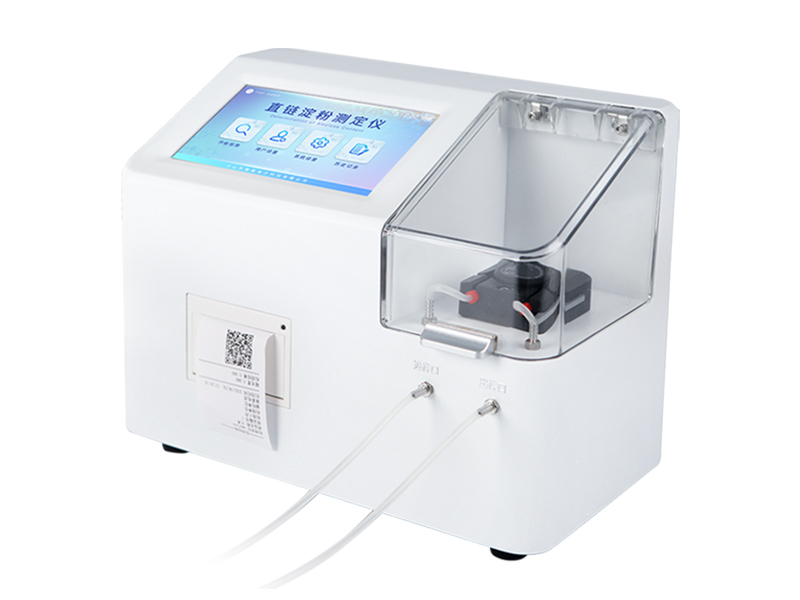
The amylose tester, utilizing automatic sampling technology and photoelectric detection technology, achieves rapid detection in 20 seconds with a detection accuracy of ±1%, providing a new means of quality control for the grain industry.
I. Operating Principle and System Design of Amylose Tester
1.1 Detection principle
Based on the color development difference between amylose/amylopectin and iodine:
Amylose: forms a deep blue complex with iodine
Amylopectin: forms a reddish-brown complex
The instrument synchronously measures through a four-wavelength optical system:
470nm: reference wavelength (to eliminate background interference)
620nm: characteristic absorption of amylose
540nm: characteristic absorption of amylopectin
680nm: Total starch correction
1.2 Instrument architecture
Sample injection system: peristaltic pump flow detection throughput of 30 samples/hour
Optical system: LED cold light source + silicon photodiode, with a transmittance repeatability of ≤0.3%
Electronic system: ARM Cortex-A53 processor completes data analysis in 20 seconds
Data management: Android 7.1 system supports wireless/USB flash drive export
II. Technical Advantages of Amylose Tester
1. Performance testing
Detection range: 0-50%
Detection accuracy: ±1%
Detection time: 20 seconds per sample
Four-wavelength synchronous detection
2. Degree of automation
Continuous flow injection (no limit on sample quantity)
Automatic optical alignment
Automatic data storage and analysis
One-click operation
3. Intelligent functions
7-inch touch screen (Android system)
WiFi data upload
Cloud data management
Export data from USB flash drive
4. Stability performance
Automatic light intensity adjustment (no temperature drift)
Long-term drift <1%FS (24h)
Transmittance repeatability ≤ 0.3%T
III. Industry Application Scenarios and Solutions
1. Main application areas
Grain processing: raw material quality control
Food production: Recipe optimization
Breeding research: variety quality evaluation
Quality inspection: third-party inspection agency
Warehouse management: storage quality monitoring
2. Typical problems and solutions
Low detection efficiency: 20-second quick detection
Complex operation: one-click automated operation
Data management is challenging: cloud-based data management platform
Unstable results: Four-wavelength calibration technique
Multiple sample restrictions: continuous flow sample feeding design
As an innovative achievement in grain testing technology, the amylose tester plays a significant role in starch quality testing due to its speed, accuracy, and automation. Choosing a reliable amylose tester can not only significantly enhance testing efficiency and reduce labor costs, but also provide accurate data support for product development and quality control.
Article address:http://www.graintesting.cn/news/51.html
- Previous: Straight chain starch analyzer: a new benchmark for rapid detection of grain quality
- Next: Rice freshness tester: Quickly identify stale grains in 1 minute
Related products
Related articles
-
What are the functions and characteristics of the rice processing accuracy tester?
2025-08-01 -
Portable Rapeseed Analyzer for Instant Rapeseed Quality Data
2025-10-17 -
Fatty acid value tester: 10-minute rapid detection
2025-08-01 -
HM-Y100 Portable Near-Infrared Rapeseed Analyzer Product Knowledge Graph White Paper
2025-12-24 -
Near infrared wheat analyzer: Reshaping grain quality detection
2025-07-25 -
Rice Processing Accuracy Detector |Automated Milling Precision Analysis
2025-10-17 -
Near-Infrared Wheat Analyzer Product Knowledge Graph Whitepaper
2025-12-04 -
Portable rapeseed analyzer: a new paradigm of non-destructive and efficient quality control
2025-07-25