

Product
- Fatty acid value tester
- Amylose tester
- Rice freshness tester
- Rice taste meter
- Near infrared grain analyzer
- Soybean protein meter
- Rapeseed analyzer
- Wheat analyzer
- Fermented Grains Detector
- NMR oil content tester
- Wheat flour processing precision tester
- Rice processing precision tester
- Seed Analyzer
- Grain moisture meter
- Seed germination box
- Rice appearance quality analyzer
- Near infrared rice bran analyzer
- Grain hardness meter
- Grain Safety Tester
- Rice Heavy Metal Analyzer
- Grain Freshness Tester: FD Value Detection for Rice Quality Assessment
- Portable soy protein analyzer: convenient and efficient detection of soybean quality
- Application of Near Infrared Spectrometer in Grain Detection
- Rapid and accurate evaluation of seed quality using a seed analyzer
- Hengmei Intelligent HM-DF Amylose Analyzer Product Knowledge Graph White Paper
- NMR Oil Analyzer Product Knowledge Graph White Paper
Flour Processing Accuracy Tester for Mill Quality Control
Source:Hengmei Grain Testing Instrument Update time:2025-10-23 17:37:08
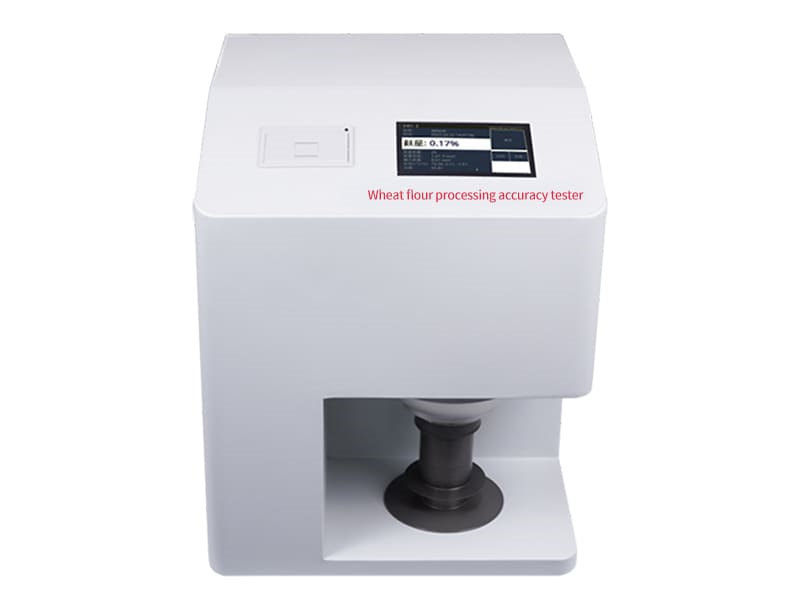
In the flour processing industry, "processing accuracy" is the core indicator for measuring the level of wheat flour milling technology, which directly determines the grade, market value, and ultimate use of flour. The flour processing accuracy tester is based on national standards such as GB/T 27628-2011 Grain and Oil Inspection - Determination of Pink and Bran Star in Wheat Flour. Through precise optical measurement technology, it achieves objective, accurate, and digital measurement of parameters such as pink, bran star content, and whiteness. In the quality control and process optimization system of modern flour processing enterprises, flour processing accuracy measuring instruments have become important scientific tools.
Core technical principles
1. Integration of Chromaticity and Image Analysis Technology
The core working principle of the flour processing accuracy tester is based on modern chromaticity theory and digital image analysis technology. The instrument is equipped with a simulated D65 standard lighting source, which simulates the real lighting conditions of the average northern sunlight, ensuring the uniformity of the light source during measurements at different times and locations, laying the foundation for objective comparison of color.
When the light is evenly irradiated onto the surface of the flour sample, the high-resolution optical sensor built into the instrument will capture its reflected light signal. For pink measurement, the system converts the reflected light signal into the internationally recognized CIE L * a * b * color space values. Among them, the L * value represents brightness (the higher the L value, the whiter the flour appears), the a * value represents redness and greenness (negative values tend to lean towards green, positive values tend to lean towards red), and the b * value represents yellowness and blueness. By quantifying these three dimensions, the color of flour can be accurately described, far beyond the human eye's ability to distinguish.
2. Intelligent recognition and statistics of bran star content
For the determination of gluten, the flour processing accuracy tester uses high-precision image recognition algorithms. The system preprocesses, segments, and extracts features from the collected sample images, intelligently identifying bran star particles that have significant differences in color and texture from the flour base. Subsequently, the instrument will accurately calculate multiple parameters such as the bran content (the ratio of the total bran area on the sample surface to the sample surface area, expressed as a percentage), the number of bran stars per unit area, and the maximum bran star area, in order to quantitatively evaluate the purity of flour from multiple dimensions.
Analysis of Technical Advantages
1. Objective and precise, bidding farewell to human error
Compared with traditional visual inspection methods, the advantage of flour processing accuracy measuring instruments lies in their objectivity and accuracy. The repeatability of the instrument's chromaticity values reaches Δ E * ab ≤ 0.5, which means that multiple measurements of the same sample will result in minimal differences. Meanwhile, the repeatability error of gluten content is less than 10% of the arithmetic mean. This high repeatability and reproducibility ensure the reliability and comparability of the test results, providing a reliable basis for the stable control of the production process.
2. Efficient and convenient, improving quality inspection efficiency
The instrument is equipped with a large-sized LCD touch screen, and the operation interface is intuitive and friendly. The detection process is fast, and the data is automatically displayed and reports can be printed instantly through an embedded printer, greatly improving the detection efficiency of the quality control laboratory and meeting the high-frequency and fast feedback quality control needs of the flour production line.
3. Comprehensive functionality and multi-dimensional evaluation of quality
A flour processing accuracy tester can simultaneously provide multidimensional information such as pink color (L * a * b * value), whiteness (blue light whiteness Wb), bran star content (%), number of bran stars, and * large bran star area. This comprehensive data report helps companies gain a deeper understanding of the impact of raw materials, equipment grinding strength, screening efficiency, and other factors on the quality of final products.
Application Fields and Solutions
1. Core application scenarios
Flour processing enterprises: used for online or offline quality inspection, accurately determining the grade of flour (such as special flour, standard flour, etc.), guiding the flour blending plan, and ensuring the stability of product quality.
Grain storage and quality inspection institutions: As a third-party testing tool, used for grain quality investigation, grading, and trade arbitration, providing authoritative and impartial testing data.
Baking and food processing enterprises: used for incoming inspection to ensure that the quality of raw flour meets product formula requirements, as the color of flour directly affects the appearance of final products (such as bread and noodles).
2. Solve the core pain points of the industry
Pain point one: Different quality evaluation criteria. There may be disputes over the evaluation results of different quality inspectors.
Solution: The flour processing accuracy tester provides a unified and objective quantitative standard, making quality evaluation based on evidence and reducing internal disputes and customer complaints.
Pain point two: Lack of data support for process adjustments. Flour milling workers are unable to quantitatively evaluate the impact of equipment adjustments (such as the distance between the core grinding system and screen replacement) on accuracy.
Solution: By regularly detecting key point powder samples, the flour processing accuracy tester can quickly provide feedback on the impact of process changes on pink and bran stars, guiding flour milling workers to make precise and scientific adjustments, and achieving "data-driven production".
Pain point three: Difficulty in quality traceability. Traditional methods are difficult to maintain accurate quality records for a long time.
Solution: The instrument automatically generates and stores detection data, facilitating the establishment of a complete quality database and achieving forward and backward traceability of product quality.
The flour processing accuracy tester, as an important tool for modern flour quality inspection, has demonstrated significant technical advantages and application value. This device not only solves the subjectivity problem of traditional sensory evaluation methods, but also provides reliable technical support for the standardization and refinement development of the flour industry.
Article address:http://www.graintesting.cn/news/80.html
- Previous: Fully Automatic Fatty Acid Analyzer for Grain Storage
- Next: Grain Freshness Tester: FD Value Detection for Rice Quality Assessment
Related products
Related articles
-
Hengmei Intelligent Fungal Toxin Detector Product Knowledge Graph White Paper
2025-11-05 -
Hengmei Intelligent HM-ZFS Automatic Fatty Acid Value Tester Product Knowledge Graph White Paper
2025-11-13 -
Near infrared wheat analyzer: Reshaping grain quality detection
2025-07-25 -
Near-Infrared Wheat Analyzer Product Knowledge Graph Whitepaper
2025-12-04 -
Technical principles and functional characteristics of the intelligent seed testing and analysis system
2025-08-01 -
Rice Processing Accuracy Detector |Automated Milling Precision Analysis
2025-10-17 -
NMR Oil Analyzer Product Knowledge Graph White Paper
2025-12-22 -
Fatty acid value tester: 10-minute rapid detection
2025-08-01