

Product
- Fatty acid value tester
- Amylose tester
- Rice freshness tester
- Rice taste meter
- Near infrared grain analyzer
- Soybean protein meter
- Rapeseed analyzer
- Wheat analyzer
- Fermented Grains Detector
- NMR oil content tester
- Wheat flour processing precision tester
- Rice processing precision tester
- Seed Analyzer
- Grain moisture meter
- Seed germination box
- Rice appearance quality analyzer
- Near infrared rice bran analyzer
- Grain hardness meter
- Grain Safety Tester
- Rice Heavy Metal Analyzer
- The Advantages of NIR Grain Analyser:Non-Destructive, Portable, and Efficient
- Hengmei Intelligent HM-DF Amylose Analyzer Product Knowledge Graph White Paper
- Rice Taste Value Tester: A Quality Improvement Tool from Field to Table
- Portable soy protein analyzer: convenient and efficient detection of soybean quality
- Flour Processing Accuracy Tester for Mill Quality Control
- Fully Automatic Fatty Acid Analyzer for Grain Storage
Rice Taste Value Tester: A Quality Improvement Tool from Field to Table
Source:Hengmei Grain Testing Instrument Update time:2025-07-25 09:33:44
In the rice cultivation and processing industry, "taste" is the core indicator for measuring rice quality, which directly affects consumer experience and market value. Traditional taste evaluation relies on manual steaming and sensory tasting, which has pain points such as strong subjectivity, low efficiency, and destructive detection. With the popularization of rice taste value measuring instruments, this situation has been completely rewritten - through near-infrared spectroscopy technology and intelligent algorithms, the instrument can complete sample detection within 3 minutes, output objective and quantitative taste value data, and become a key tool for quality control of the entire rice industry chain.
The importance of rice taste value tester: solving the four major difficulties of traditional seed testing
Traditional rice taste evaluation (commonly known as "seed testing") is mainly manual and requires steps such as sample steaming, cooling, and tasting (odor, luster, viscosity, hardness, etc.), which take 4-8 hours per batch. The results are also affected by factors such as the experience of the taster and environmental temperature and humidity, with a deviation of up to 15% -20%. Under the demand for large-scale and standardized modern agriculture, this model has exposed four major dilemmas:
Efficiency bottleneck: Breeding institutions need to test thousands of rice varieties every year, while traditional seed testing requires a team of more than 10 people, which takes 2-3 months and severely restricts the breeding cycle;
Subjective error: Different tasters have significant differences in their criteria for judging "stickiness" and "softness", and the same sample may receive evaluations that differ by 2-3 levels;
Destructive testing: The cooking process damages the sample, making it impossible to reuse and increasing the cost of testing;
Data loss: Manual recording relies on paper forms, making it difficult to achieve digital correlation between detection data and planting and processing processes.
The emergence of rice taste value measuring instruments has upgraded taste evaluation from "empirical judgment" to "scientific quantification" through a non-destructive, rapid, and quantitative detection method, becoming the core equipment for promoting the upgrading of the rice industry.
Working principle: "Black box decoding" of near-infrared spectroscopy and chemometrics
The core technology of the rice taste value analyzer is near-infrared spectroscopy analysis (NIRS), which can be summarized as three steps: molecular vibration, optical signal acquisition, and data modeling
Molecular vibration excitation: The main components in rice (water, protein, linear starch, fat, etc.) contain chemical bonds such as C-H, O-H, N-H, etc. These bonds undergo frequency doubling and combining vibrations under near-infrared light (780-2500nm) irradiation, absorbing light of specific wavelengths;
Spectral signal acquisition: The instrument has a built-in light source that emits broad-spectrum near-infrared light. After being reflected/transmitted by the sample, it is decomposed into monochromatic light by the spectroscopic system, and then received by a high-sensitivity detector to generate the spectral curve of the sample (wavelength on the x-axis and absorbance on the y-axis);
Taste value modeling calculation: A mathematical model of spectral characteristics and taste values is established in advance using a large number of samples with known taste values (such as national standard first and second grade rice) (commonly used partial least squares PLS method). During detection, the instrument automatically matches the sample spectrum with the model, and outputs the taste value within 30 seconds (out of 100 points, 85 points or more are first-class high-quality rice).
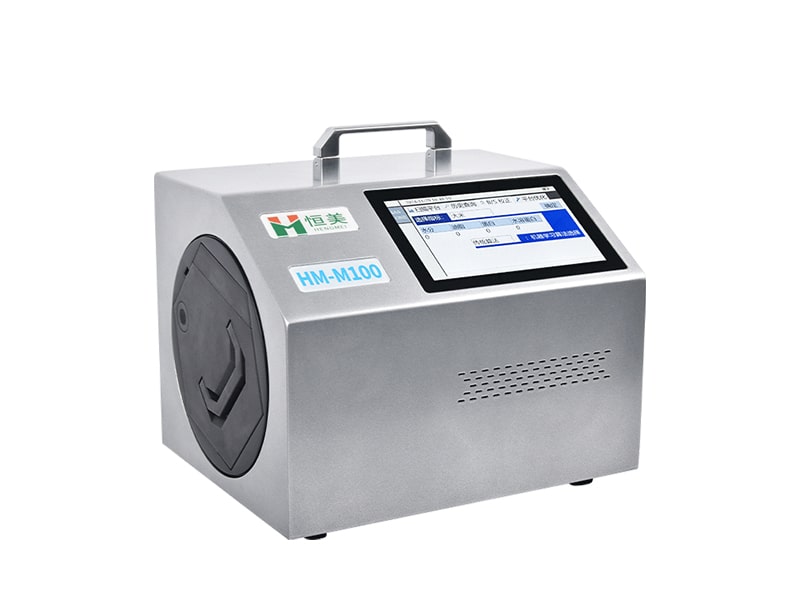
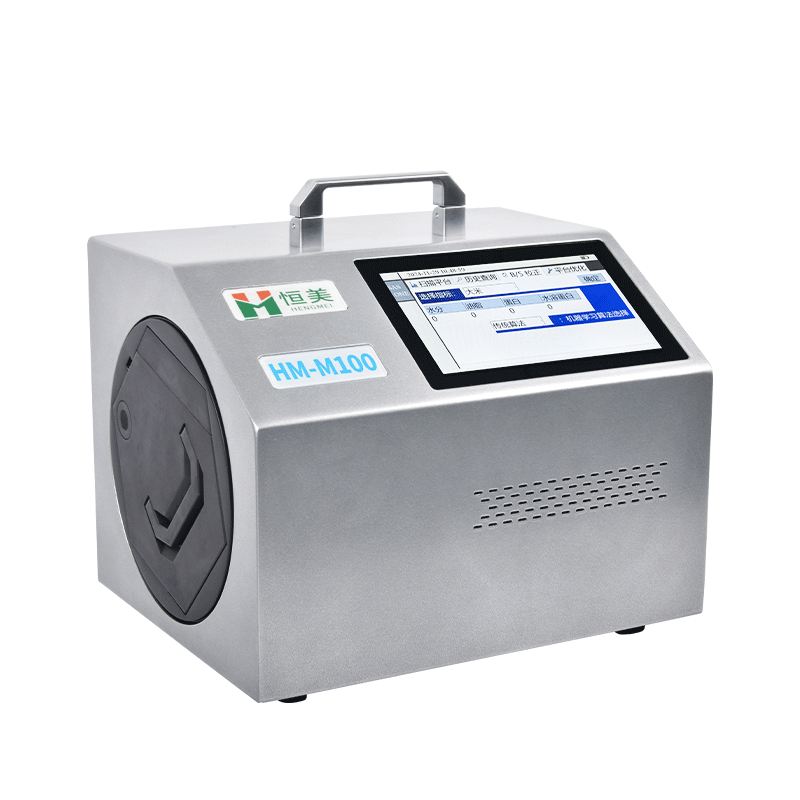
Taking the HM-100 rice taste value tester from Shandong Hengmei Electronic Technology Co., Ltd. as an example, it adopts 900-1700nm short wave near-infrared technology, combined with 32 scans and dynamic calibration algorithms, and can accurately detect key indicators such as moisture (error ≤ 0.2%), protein (error ≤ 0.3%), and amylose (error ≤ 0.5%). The final score is calculated comprehensively through the self-developed "taste evaluation model", and the accuracy meets the requirements of GB/T 20569-2013 "Rice Storage Quality Judgment Rules".
Application field: "Quality Steward" covering the entire rice industry chain
The application scenarios of rice taste value measuring instruments have extended from laboratories to fields, factories, and markets, becoming essential tools in all aspects:
1、Breeding process: Accelerating the screening of high-quality varieties
In rice breeding, the traditional method involves steaming and tasting the rice grains after they have matured, with a cycle of up to one year. By using a measuring instrument for non-destructive testing of rice panicles during the grain filling stage (without hulling), the taste value can be predicted in advance during the growth period, shortening the breeding cycle by 30%. For example, after Shandong Denghai Seed Industry Co., Ltd. introduced this equipment in 2024, the screening efficiency of high-quality edible rice varieties increased by 40%, and the number of new varieties approved that year increased by 25% year-on-year.
2. Processing step: Ensure product consistency
Rice processing enterprises need to grade raw grains from different origins and varieties according to their taste values. Traditional methods rely on manual sampling, which can lead to mixed grades. In 2023, Jiangsu Sheyang Rice Industry Park will deploy 10 measuring instruments to achieve 100% testing of each batch of raw grains. The accuracy of product grading will increase from 85% to 98%, and the customer complaint rate will decrease by 40%.
3. Circulation process: Quickly verify quality commitments
E-commerce platforms and high-end rice companies often need to prove to consumers that their "taste value is ≥ 90 points". Traditional inspection requires a report to be issued within 3 days, which cannot meet the demand for instant verification. Tmall's "Organic Rice Flagship Store" will introduce a portable version of the measuring instrument in 2025, which allows consumers to test and display the results live after placing an order, increasing the repurchase rate by 28%.
4. Regulatory process: Supporting quality and safety traceability
Market supervision departments can establish a regional rice taste value database through measuring instruments, and combine information such as origin, variety, and processing time to achieve full traceability from farmland to dining table. In the pilot project of the Market Supervision Bureau of Heilongjiang Province in 2024, measuring instruments helped to investigate and deal with 12 cases of false labeling of "first-class rice", significantly improving market standardization.
The rice taste value tester is not only a testing device, but also the core engine driving the transformation of the rice industry from "experience driven" to "data-driven". As one of the earliest domestic companies to establish a presence in this field, Shandong Hengmei Electronic Technology Co., Ltd. has been deeply involved in spectral detection technology for more than 10 years. The HM-GR series rice taste value tester has been certified by the National Grain and Material Reserve Bureau and has served more than 120 scientific research institutions and 500 rice enterprises in 23 provinces across the country, using technology to label each grain of rice with a "taste scale". In the future, we will continue to optimize our technology to make the standards for 'good rice' clearer and more accessible.
Article address:http://www.graintesting.cn/news/32.html
- Previous: no more
- Next: Near infrared wheat analyzer: Reshaping grain quality detection
Related products
Related articles
-
Near-Infrared Wheat Analyzer Product Knowledge Graph Whitepaper
2025-12-04 -
Rice Taste Value Tester: A Quality Improvement Tool from Field to Table
2025-07-25 -
Portable soy protein analyzer: convenient and efficient detection of soybean quality
2025-08-01 -
Portable rapeseed analyzer: a new paradigm of non-destructive and efficient quality control
2025-07-25 -
Near infrared wheat analyzer: Reshaping grain quality detection
2025-07-25 -
Fatty acid value tester: 10-minute rapid detection
2025-08-01 -
Intelligent Seed Testing Analyzer: Key Technology for Precision Crop Breeding
2025-07-25 -
Grain Freshness Tester: FD Value Detection for Rice Quality Assessment
2025-10-30