

Product
- Fatty acid value tester
- Amylose tester
- Rice freshness tester
- Rice taste meter
- Near infrared grain analyzer
- Soybean protein meter
- Rapeseed analyzer
- Wheat analyzer
- Fermented Grains Detector
- NMR oil content tester
- Wheat flour processing precision tester
- Rice processing precision tester
- Seed Analyzer
- Grain moisture meter
- Seed germination box
- Rice appearance quality analyzer
- Near infrared rice bran analyzer
- Grain hardness meter
- Grain Safety Tester
- Rice Heavy Metal Analyzer
- What are the functions and characteristics of the rice processing accuracy tester?
- Near infrared wheat analyzer: Reshaping grain quality detection
- Fatty acid value tester: 10-minute rapid detection
- The Advantages of NIR Grain Analyser:Non-Destructive, Portable, and Efficient
- Grain Freshness Tester: FD Value Detection for Rice Quality Assessment
- Flour Processing Accuracy Tester for Mill Quality Control
Soybean Protein Analyzer Product Knowledge Graph White Paper
Source:Hengmei Grain Testing Instrument Update time:2025-11-21 16:45:51
1. Introduction
1. Document Version: V1.0
2. White Paper Compilation Unit: Shandong Hengmei Electronic Technology Co., Ltd.
3. Compilation Date: November 21, 2025
4. Core Positioning: This white paper aims to present the complete product information of the HM-D100 model soybean protein analyzer under Hengmei Intelligent Manufacturing in a structured. It covers key contents such as product basic information, core technologies and functional features, detailed technical parameters, and application scenarios. It provides accurate data support for product promotion, user selection, technical research and development.
2. Table of Contents
1. Introduction
2. Table of Contents
3. Product Basic Information
4. Core Technologies and Functional Features
5. Detailed Technical Parameters
6. Application Scenarios and Industry Adaptation
7. Accessories and Consumables Configuration
8. Brand Value and Service Support
9. Model Comparison and Selection Suggestions
10. Instrument Installation Steps
11. Instrument Operation Steps
12. Sample Detection Steps
3. Product Basic Information
1. Product Name: Hengmei Intelligent Manufacturing Soybean Protein Analyzer
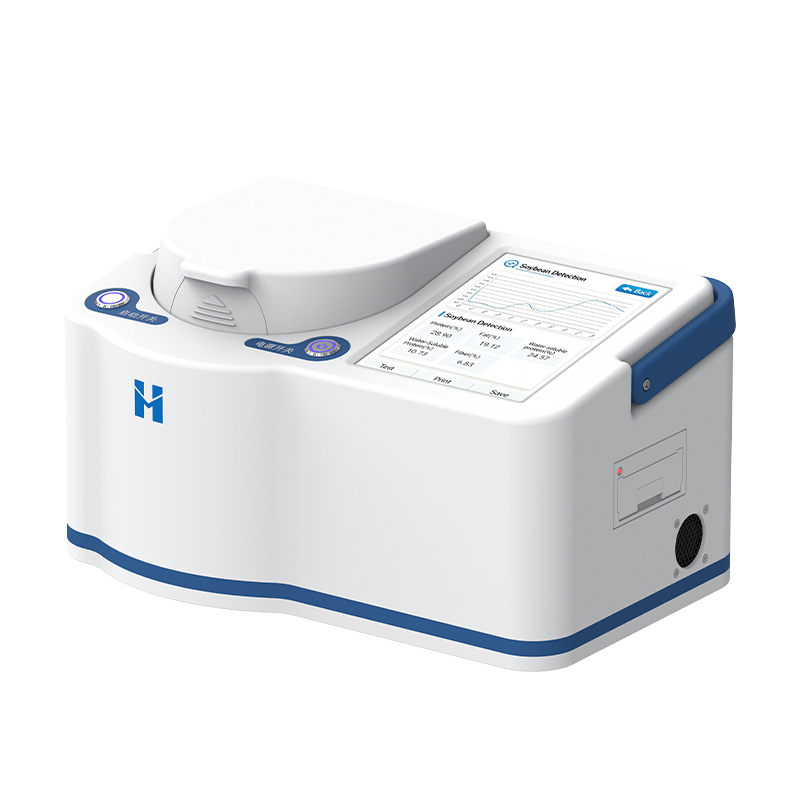
2. Model and Market Positioning: The model is HM-D100. It is a portable near-infrared soybean protein analyzer, mainly used for non-destructive detection of multiple indicators in soybeans. It has the characteristics of fast detection speed, no need for complex sample pretreatment, and portability, and is widely used in multiple links of the soybean industry chain.
3. Product Appearance and Structure: The instrument adopts a handheld design, which is easy to carry. The housing material is ABS, with a size of 380.5 mm × 249 mm × 210.5 mm and a weight of 6.5 kg, making it convenient for on-site detection. It is equipped with a display screen for operation and result display, a built-in next-generation high-speed thermal printer for printing detection reports, and a sample warehouse for placing soybean samples. There are also a power switch, start switch, USB port, power port, and vents on the instrument to ensure normal operation and heat dissipation.
4. Core Technologies and Functional Features
1. Near-Infrared Spectroscopy Detection Technology: The instrument uses near-infrared spectroscopy technology. The spectral information collected contains overtone vibration or rotational information of chemical bonds such as N-H, C-H, O-H, and C-O in components like protein, fat, moisture, fiber, and water-soluble protein molecules in soybeans. By establishing a mathematical correlation between spectral information and the measured substance components through chemometric methods, quantitative analysis of relevant detection indicators is achieved, enabling non-destructive and accurate detection.
2. Fast Detection Technology: The detection speed of the instrument is fast. It can measure soybean indicators within 1 to 1.5 minutes (the specific test time is 80 seconds), which greatly shortens the detection cycle, improves detection efficiency, and reduces time and labor costs compared with traditional detection methods that require complex pre-treatment and long detection time.
3. Comprehensive Detection Function: It can simultaneously detect multiple indicators in soybeans, including protein, fat, moisture, fiber, and water-soluble protein, covering the main nutrient indicators concerned in the soybean industry, meeting the diverse detection needs of users in different scenarios.
4. Non-Destructive and Environmentally Friendly Technology: No complex pre-treatment of samples is required during the detection process, and the sample is not damaged, which is convenient for subsequent processing or reuse of samples. At the same time, no chemical reagents are used, no chemical fertilizers or other pollutants are generated, and it is environmentally friendly and harmless, conforming to the concept of green detection.
5. Portable Design Technology: The handheld design of the instrument, combined with its moderate size and weight, allows it to be used anytime and anywhere, facilitating on-site detection and analysis in fields such as soybean planting bases, processing plants, and trading sites, breaking the limitation of traditional laboratory-based detection.
6. Good Repeatability Technology: The instrument adopts advanced design, such as a cutting-edge grating transmission detection method, which covers the full wavelength range from 950 to 1650 nm, ensuring high consistency among instruments and accurate calibration transfer. This reduces human operational errors and interference from different scenario conditions, making the detection results have good repeatability.
7. Intelligent Operation Technology: It is equipped with an Android 11 operating system and a touchscreen keyboard design. The software interface is user-friendly, and the operation is simple and straightforward. Users can master the operation without complex training, improving the convenience of instrument use.
8. Data Storage and Output Technology: The instrument supports image and table storage formats for storing detection data. It is also equipped with a built-in high-speed thermal printer, which can print detection reports and data tables in a timely manner, providing users with paper documents for record-keeping and reference. In addition, it has a communication function (optional 4G module) to facilitate data upload and sharing.
5. Detailed Technical Parameters
1. Applicable Sample Type: Particle sample (soybean)
2. Light Source: Tungsten halogen lamp, with a service life of 10,000 hours
3. Wavelength Range: 950 - 1650 nm
4. Wavelength Resolution: 1.7 nm
5. Spot Diameter: 25 mm
6. Test Time: 80 s
7. Sample Chamber Capacity: 500 g
8. Housing Material: ABS
9. Operating System: Android 11
10. Operating Temperature: 10 - 30 ℃
11. Battery Life: 1 h
12. Power Supply Voltage: 12.6 V
13. Communication Function: Optional 4G module
14. Size: 380.5 mm × 249 mm × 210.5 mm
15. Weight: 6.5 kg
6. Application Scenarios and Industry Adaptation
1. Soybean Breeding Field: At the breeding end, the instrument can quickly detect the protein, fat, moisture, and other indicators of soybean germplasm resources, helping breeders screen high-quality germplasm resources, accelerate the breeding process, and improve the quality of new soybean varieties.
2. Soybean Processing Industry: In soybean processing enterprises such as oil, food, and feed production, the instrument is used for raw material acceptance to detect the quality indicators of purchased soybeans and ensure that the raw materials meet the production requirements. During the production process, it can also monitor the quality changes of soybeans in real-time to realize process control and ensure the stability of product quality.
3. Soybean Trading Link: In the soybean trading process, whether it is spot purchase or futures delivery, the instrument can be used for on-site rapid detection of soybean quality indicators. It helps buyers and sellers quickly evaluate the quality of soybeans, determine a reasonable price, and avoid disputes caused by quality problems.
4. Scientific Research and Testing Institutions: Scientific research institutions and testing laboratories can use this instrument to conduct component analysis of soybeans, carry out relevant scientific research projects, such as studying the influence of different planting conditions on soybean nutrient components, and provide accurate detection data support for scientific research. At the same time, it can also undertake the testing tasks of soybean samples from the society to provide professional testing services.
7. Accessories and Consumables Configuration
1. Basic Instrument Accessories: 1 HM-D100 soybean protein analyzer main unit; 1 power adapter with specifications of 12.6 V 5 A, used to charge the instrument or supply power during fixed use; 1 sample bin brush, used to clean the sample bin and remove residual soybean particles; 1 instruction manual, which records the instrument's functions, operation methods, maintenance precautions, etc.; 1 certificate of conformity, proving that the instrument meets the relevant quality standards; 1 warranty card, which specifies the warranty scope and duration of the instrument.
2. Consumables: 1 roll of thermal paper with specifications of 57 mm × 20 mm, used for the instrument's built-in thermal printer to print detection reports and data.
8. Brand Value and Service Support
1. Brand Value: As the owner of the "Hengmei Intelligent Manufacturing" brand, Shandong Hengmei Electronic Technology Co., Ltd. is committed to the research and development, production, and promotion of agricultural detection equipment. The HM-D100 soybean protein analyzer launched by the company integrates advanced near-infrared spectroscopy technology and intelligent design. It solves the problems of slow speed, complex operation, and poor portability of traditional soybean detection equipment. It provides efficient and accurate detection tools for the soybean industry, helps improve the quality control level of the soybean industry chain, and has established a good brand image in the field of agricultural detection equipment with reliable product quality and excellent performance.
2. Service Support:
◦ Pre-Sales Service: The company provides users with detailed product introductions, including the functional characteristics, technical parameters, application scenarios, and usage methods of the HM-D100 soybean protein analyzer. It also offers one-on-one selection consultation services. According to the user's actual needs, such as the scale of soybean processing, detection frequency, and on-site use requirements, it helps users confirm whether the HM-D100 model is suitable and answers various questions raised by users to assist users in making correct purchase decisions.
◦ In-Sales Service: After the user purchases the instrument, the company provides guidance on unpacking and inspection to help the user check whether the instrument and its accessories are complete and intact. If there is any problem, it assists the user in communicating with the relevant departments to solve it in a timely manner. At the same time, it provides guidance on the preparation work before instrument installation, such as the requirements for the use environment and power supply.
◦ After-Sales Service: The company provides free instrument operation training services. It can conduct on-site training or online video training according to the user's needs to help users master the operation skills of the instrument, including power-on preheating, parameter setting, sample detection, data processing, etc. During the use of the instrument, if the user encounters technical problems or malfunctions, they can contact the company's after-sales service personnel through the contact number (8619053628381), company email (hengmeiyiqi@126.com), or by visiting the company's official website . The after-sales team will provide timely fault diagnosis and maintenance guidance. If the instrument needs to be repaired, the company will handle it in accordance with the warranty provisions. For consumables such as thermal paper, the company provides purchase guidance to ensure that users can purchase genuine consumables in a timely manner.
9. Model Comparison and Selection Suggestions
1. Model Comparison: Currently, Hengmei Intelligent Manufacturing mainly provides the HM-D100 model for the soybean protein analyzer product line, and there are no other models in the same series for the time being. Therefore, there is no comparison of functions, parameters, and prices between different models. The HM-D100 model has comprehensive detection functions, covering the main nutrient indicators of soybeans, and has the advantages of fast detection speed, non-destructive detection, and portability. It can meet the detection needs of most users in the soybean industry.
2. Selection Suggestions: If the user needs to detect indicators such as protein, fat, moisture, fiber, and water-soluble protein in soybeans, and has requirements for detection speed (needing results within 1-1.5 minutes), sample non-destructiveness (not wanting to damage samples), and portability (needing on-site detection), the HM-D100 soybean protein analyzer is the preferred product. It is suitable for soybean breeding institutions, soybean processing enterprises, soybean trading companies, scientific research institutions, and testing laboratories. Whether it is for raw material acceptance, process control, trading pricing, or scientific research testing, the HM-D100 model can provide stable and reliable detection services.
10. Instrument Installation Steps
1. Unpacking and Inspection: Open the instrument packing box, take out the HM-D100 main unit, power adapter, thermal paper, sample bin brush, instruction manual, certificate of conformity, and warranty card. Check whether each part is complete and intact according to the packing list. If there is any missing accessory or damage to the instrument, contact the seller or manufacturer in time.
2. Environment Preparation: Choose a flat, clean, and well-ventilated place to place the instrument. Avoid placing it in an environment with direct sunlight, high temperature, high humidity, severe dust, strong vibration sources, or strong electromagnetic fields. Ensure that there is at least 10 cm of space around the instrument for operation and heat dissipation, and the bearing capacity of the placement surface is more than 10 kg.
3. Accessory Installation: Install the thermal paper into the built-in thermal printer of the instrument. Open the printer cover, put one end of the thermal paper into the printer according to the indicated direction, ensure that the paper is placed smoothly without jamming, and then close the printer cover. After installation, turn on the printer briefly to test whether the printing is normal. If the printed content is clear, the installation is correct.
4. Power Connection: If using the instrument in a fixed place, connect one end of the power adapter to the power port of the instrument, and the other end to a suitable power socket. Ensure that the power supply is stable and meets the 12.6 V power supply requirement of the instrument. If using the instrument outdoors, ensure that the built-in battery of the instrument is fully charged. If the battery is low, charge it in advance through the power adapter.
5. Power-On Test: Press the power switch of the instrument to turn on the instrument. Wait for the instrument to start up and initialize. Observe whether the display screen can normally display the startup interface and enter the main operation interface. Check whether each functional module (such as detection module, printing module) can be normally accessed. If there is an abnormal prompt, refer to the instruction manual to troubleshoot or contact technical support personnel.
11. Instrument Operation Steps
1. Power-On and Preheating: Press the power switch to start the instrument. The instrument will automatically complete the system startup and initialization process and then enter the preheating stage. If the instrument is turned on for the first time on the same day, it is recommended to preheat it for 15-30 minutes to ensure that all internal components of the instrument are in a stable working state, which helps improve the accuracy of detection results. During preheating, the display screen may show a preheating prompt or countdown.
2. System Parameter Setting: After preheating, the instrument enters the main startup interface, which displays functional options such as "Start Detection", "History", and "System Settings". Click the "System Settings" option to enter the parameter setting interface. Set the inspector information (it is recommended to enter the real name or qualification certificate number of the tester to ensure the traceability of detection data), test unit information (enter the full name of the unit to avoid illegal use of other units' information), and preset upload username and password. The upload address is generally preset by the system (http://39.98.237.174:80) and does not need to be modified unless there are special requirements. After setting the parameters, click the "Back" button to return to the main startup interface.
3. Enter Detection Interface: On the main startup interface, click the "Start Detection" option to enter the start detection main interface. This interface is equipped with a back button (to return to the main startup interface), a detection key (to start sample detection), a print button (to print detection reports), and a save button (to save detection results).
4. Sample Loading: Before loading samples, remove impurities and broken grains from the soybean samples to ensure the purity of the samples. Then, take about 250 g of the treated soybean sample and evenly pour it into the sample bin of the instrument. Arrange the samples in the specified direction to ensure that the samples are evenly distributed in the sample bin, which is conducive to the collection of accurate spectral information.
5. Spectral Collection and Result Calculation: Place the sample bin with the loaded samples into the instrument correctly. Click the "Detection" button on the detection interface. The instrument will prompt the user to enter the predetermined sample number. After entering the sample number, the instrument starts to collect the near-infrared spectrum of the soybean sample (by default, it collects 100 frames and takes the average value, with a smoothness of 6). Based on the Partial Least Squares Regression (PLSR) model, the instrument calculates the contents of protein, fat, water-soluble protein, moisture, and fiber in the soybeans. After the calculation is completed, the detection results are displayed on the screen.
6. Data Processing: If the detection results need to be saved, click the "Save" button to store the current detection results in the local device for later viewing and use. If you need to print the detection report, click the "Print" button, and the built-in thermal printer will print the detection report, which includes information such as sample number, detection time, inspector, test unit, and various indicator contents. To ensure the accuracy of the detection results, it is recommended to test the same sample 3-5 times and take the average value as the final detection result.
7. Post-Detection Operation: After the detection of one sample is completed, take out the sample bin, pour out the detected soybeans, clean the sample bin with a sample bin brush to remove residual soybean particles, and prepare for the detection of the next sample. If no more samples need to be detected, click the "Back" button to return to the main startup interface, then turn off the instrument power switch, disconnect the power connection (if using a power adapter), and clean the surface of the instrument.
12. Sample Detection Steps
1. Sample Preparation: Select representative soybean samples. First, remove impurities such as stones, soil, and broken leaves from the samples, and also pick out broken or moldy soybean grains to ensure that the samples are free from impurities and have good quality. This step is crucial to avoid the impact of impurities on the detection results.
2. Sample Loading: Take about 250 g of the prepared soybean sample and evenly pour it into the sample bin of the HM-D100 soybean protein analyzer. During the loading process, pay attention to arranging the samples in the direction specified by the instrument to ensure that the samples are evenly distributed in the sample bin, without accumulation or gaps, so that the instrument can collect complete and accurate spectral information.
3. Instrument Preparation: Turn on the instrument power, preheat the instrument for 15-30 minutes (especially for the first startup of the day) to ensure that the instrument components are stable. Enter the "System Settings" interface to set the inspector, test unit, and other parameters, and then enter the "Start Detection" interface to prepare for detection.
4. Spectral Collection: Place the sample bin with the samples into the instrument. Click the "Detection" button, enter the sample number as prompted, and the instrument starts to collect the near-infrared spectrum of the sample. The collection process is automatically completed by the instrument, and the user only needs to wait for the collection to finish.
5. Result Calculation and Display: After the spectral collection is completed, the instrument uses the built-in PLSR model to analyze and calculate the spectral data, and obtains the contents of protein, fat, water-soluble protein, moisture, and fiber in the soybeans. The calculation results are directly displayed on the instrument's display screen, and the user can clearly view the specific value of each indicator.
6. Result Verification and Confirmation: To ensure the reliability of the detection results, it is recommended to repeat the detection of the same sample 3-5 times. After obtaining multiple sets of detection results, calculate the average value. If the difference between each set of results is small (within the allowable error range), the average value is taken as the final detection result of the sample; if the difference is large, check whether the sample loading is uniform, whether the instrument is stable, and other factors, and re-detect.
7. Result Recording and Output: Record the final detection result manually or by clicking the "Save" button on the instrument to store the result in the instrument's local memory. If a paper report is needed, click the "Print" button to print the detection report through the built-in thermal printer. The report can be used for data archiving, quality evaluation, or providing data support for subsequent work such as trading and production.
8. Post-Detection Cleaning: After the sample detection is completed, take out the sample bin from the instrument, pour out the detected soybeans, and use the sample bin brush to clean the sample bin thoroughly to remove residual soybean particles and prevent cross-contamination between subsequent samples. At the same time, wipe the surface of the instrument with a clean cloth to keep the instrument clean.
Article address:http://www.graintesting.cn/news/87.html
- Previous: Hengmei Intelligent HM-ZFS Automatic Fatty Acid Value Tester Product Knowledge Graph White Paper
- Next: Rice Freshness Tester Product Knowledge Graph Whitepaper
Related products
Related articles
-
Flour Processing Accuracy Tester for Mill Quality Control
2025-10-23 -
Amylose tester for high-throughput detection:Breed research instruments and equipment
2025-08-01 -
HM-Y100 Portable Near-Infrared Rapeseed Analyzer Product Knowledge Graph White Paper
2025-12-24 -
The Rice Taste Meter: Objective Quality Evaluation for the Modern Rice Industry
2025-09-05 -
Grain Freshness Tester: FD Value Detection for Rice Quality Assessment
2025-10-30 -
Rapid and accurate evaluation of seed quality using a seed analyzer
2025-08-01 -
How to obtain non-destructive results in 30 seconds with a nuclear magnetic resonance oil content analyzer
2025-08-01 -
Hengmei Intelligent HM-ZFS Automatic Fatty Acid Value Tester Product Knowledge Graph White Paper
2025-11-13