

Product
- Fatty acid value tester
- Amylose tester
- Rice freshness tester
- Rice taste meter
- Near infrared grain analyzer
- Soybean protein meter
- Rapeseed analyzer
- Wheat analyzer
- Fermented Grains Detector
- NMR oil content tester
- Wheat flour processing precision tester
- Rice processing precision tester
- Seed Analyzer
- Grain moisture meter
- Seed germination box
- Rice appearance quality analyzer
- Near infrared rice bran analyzer
- Grain hardness meter
- Grain Safety Tester
- Rice Heavy Metal Analyzer
- Rice Freshness Tester: A Scientific Tool for Grain Quality Control
- Grain Freshness Tester: FD Value Detection for Rice Quality Assessment
- Reshaping Standards: Accurate Analysis and Industrial Empowerment of Rice Appearance Quality Testing Instruments
- Portable Rapeseed Analyzer for Instant Rapeseed Quality Data
- Rice Taste Value Tester: A Quality Improvement Tool from Field to Table
- Near-Infrared Wheat Analyzer Product Knowledge Graph Whitepaper
Application of Near Infrared Spectrometer in Grain Detection
Source:Hengmei Grain Testing Instrument Update time:2025-08-01 16:52:20
In recent years, near-infrared spectroscopy has been widely used in grain inspection as an efficient, fast, and non-destructive detection technology, greatly improving the accuracy and efficiency of grain quality detection.
The near-infrared spectrometer can quickly analyze the types and contents of components (such as protein, moisture, oil, fiber, ash, etc.) in different substances based on the spectrum generated by near-infrared light irradiation on the sample, and can add models according to customer needs. The spectral range of the instrument is between 900-1700 nm. The instrument measures by Mantou reflection. A single measurement can detect up to 15 sub samples.
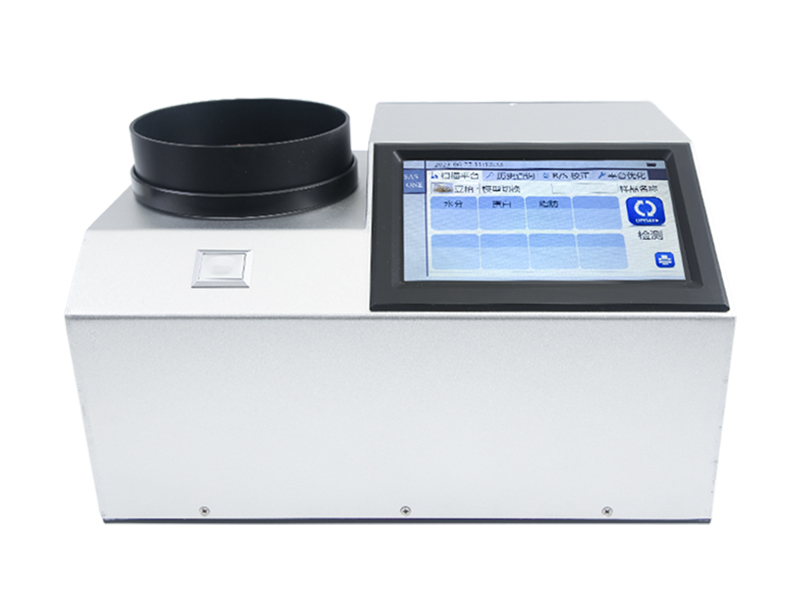
The main advantages of near-infrared spectrometer
Fast and efficient: The detection time of the instrument only takes one minute, greatly reducing the detection time and improving the detection efficiency.
Non destructive testing: Compared with traditional destructive testing methods, near-infrared technology does not require complex pre-treatment of the sample, does not require grinding of the sample, and can be injected as a whole particle, making it suitable for large-scale testing.
Multi parameter detection: The instrument uses a combination of various algorithms to switch between different models for detecting multiple samples based on their characteristics.
Easy to operate: The instrument adopts a one click operation mode, equipped with a user-friendly interface and an automated data processing system. It has a built-in self-test algorithm that can test the machine status and correct it at any time, reducing the difficulty of operation and suitable for users with various skill levels.
Application scenarios of near-infrared spectrometer
Agricultural production: During the grain harvest season, agricultural producers can use instruments to quickly detect the quality of grains, in order to adjust harvesting and drying strategies in a timely manner, and improve the quality and yield of grains.
Grain procurement and trade: Grain purchasers and traders can use instruments to quickly and accurately evaluate the quality of grains, ensuring fairness and transparency in transactions.
Grain processing: In grain processing enterprises such as flour mills and feed mills, instruments can be used for incoming inspection of raw materials and quality control during the production process to ensure stable quality of the final product.
Research and Teaching: In agricultural research institutions and higher education institutions, instruments are important research tools used for studying and teaching grain quality, promoting technological progress in related fields.
Food safety supervision: Regulatory authorities can use instruments to sample and test grain products on the market, ensuring food safety and safeguarding consumer rights.
In summary, near-infrared spectrometers have broad application prospects and important value in the field of grain detection. It can not only quickly and accurately detect various components in grains, providing strong guarantees for food security, but also help food processing enterprises achieve quality control of raw materials, and provide scientific basis for grain breeding and genetic improvement.
Article address:http://www.graintesting.cn/news/55.html
- Previous: Rice Taste Analyzer: An Intelligent Tool for Scientifically Evaluating Rice Quality
- Next: Technical principles and functional characteristics of the intelligent seed testing and analysis system
Related products
Related articles
-
Rice freshness tester: Quickly identify stale grains in 1 minute
2025-08-01 -
Rice Taste Value Tester: A Quality Improvement Tool from Field to Table
2025-07-25 -
Rice Freshness Tester Product Knowledge Graph Whitepaper
2025-12-04 -
Rapid and accurate evaluation of seed quality using a seed analyzer
2025-08-01 -
Rice Taste Analyzer: An Intelligent Tool for Scientifically Evaluating Rice Quality
2025-08-01 -
Hengmei Intelligent HM-DF Amylose Analyzer Product Knowledge Graph White Paper
2025-11-13 -
Reshaping Standards: Accurate Analysis and Industrial Empowerment of Rice Appearance Quality Testing Instruments
2025-07-25 -
HM-Y100 Portable Near-Infrared Rapeseed Analyzer Product Knowledge Graph White Paper
2025-12-24